


Aistech Space, Kreios Space, and Telespazio Ibérica, launch a pioneering project for satellite detection of forest fires
This consortium has been collaborating since January with the University of Vigo to prevent and manage wildfires through the use of Very Low Earth Orbit (VLEO) satellites capable of capturing ultra-high-resolution thermal images.
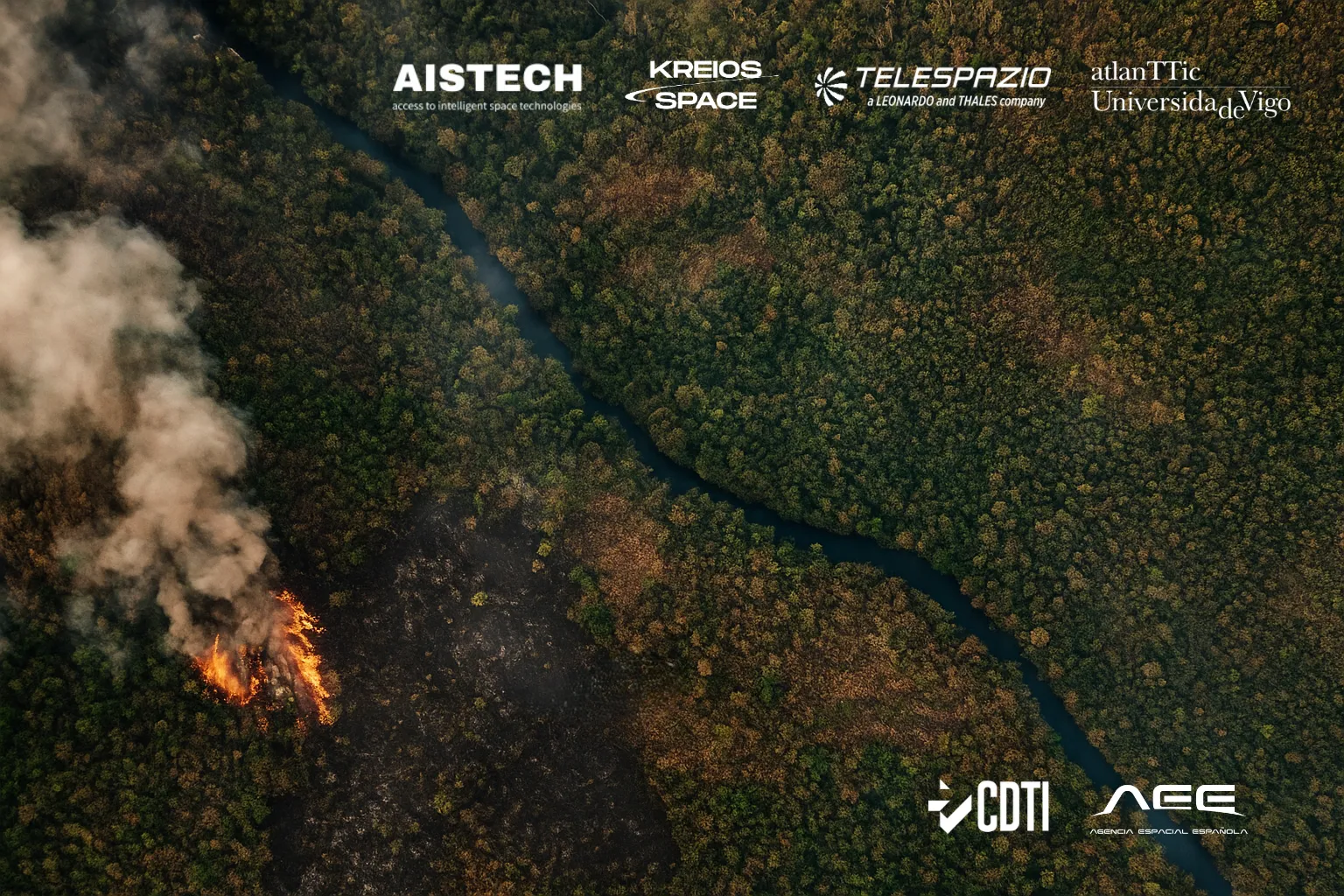
Oct. 2, 2025, Vigo, Spain — Aistech Space, Kreios Space, and Telespazio Ibérica, in collaboration with the University of Vigo, are jointly developing a next-generation satellite system for early detection and monitoring of wildfires, enabling a more effective response in the fight against fire. The project, which began in January and involves over 20 people, will last 30 months and has a budget of 4 million euros.
This initiative, awarded by the Spanish Space Agency (AEE) under the Space Technology Program, is based on the use of Very Low Earth Orbit (VLEO) satellites. Unlike current systems — which often offer insufficient resolution and revisit times of several days — this project will employ multispectral imaging systems in the infrared range, providing unprecedented resolution and revisit times below 24 hours.
Its development is structured around four key pillars: 1) a telescope optimized for fire detection; 2) a thruster enabling sustained operation in VLEO despite atmospheric drag; 3) a satellite platform operating at 200 km altitude, and 4) Artificial intelligence algorithms capable of automatically distinguishing real fires from false alarms.
A contribution to the SDGs and a sustainable future
Wildfires, as made evident by the devastating events of this past August that left thousands of hectares burned, represent a growing threat to biodiversity, public health, and community safety — while also contributing significantly to greenhouse gas emissions.
This project aligns with the Sustainable Development Goals (SDGs) by addressing the entire fire cycle: early detection, active management and control, and post-fire analysis to identify potential reignition risks. In doing so, Spain and Europe will be better prepared to respond swiftly and effectively to a threat that grows more severe every summer.
Carles Franquesa, CEO of Aistech, emphasized the importance of this collaboration: “Forming this consortium with leading partners to develop a pioneering project is a great satisfaction. It reinforces our vision for the technological development we are leading and the interest our technology is generating in today’s complex geopolitical context. Furthermore, this project will allow us to expand our team with highly qualified professionals, and we are very proud to offer these new opportunities.”
Carlos Fernández de la Peña, CEO of Telespazio Ibérica, added: “The frequent and intense fires of this past August have shown the urgent need for new tools to protect both ecosystems and communities. Our role in developing image processing algorithms places us at the heart of the project — transforming data into actionable information that helps emergency teams gain both time and precision in their response.”
Finally, Adrián Senar, CEO of Kreios Space, stated: “This project demonstrates the enormous potential of very low orbits to deliver more effective solutions to current and future challenges by applying cutting-edge technology with a direct impact on people’s lives. The Spanish Space Agency is playing a key role in turning these innovations into reality and positioning Spain at the forefront of strategic space technology development.”
Get in Touch
We’re shaping the future of satellite propulsion and VLEO missions. Whether you’re an investor, partner, or industry collaborator, we’d love to hear from you. Reach out to explore opportunities to work with Kreios Space.
Thank you for submitting the form.